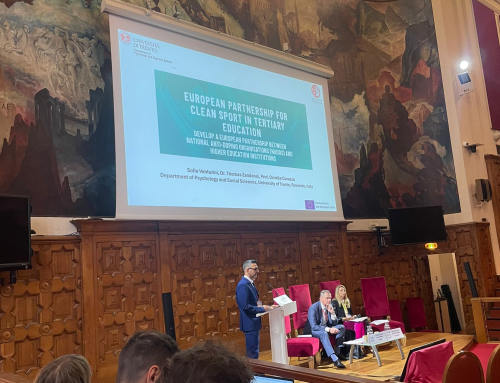
The European Partnership for Clean Sport in Tertiary Education (EPCS-TE) successfully concluded its End-of-Project Conference, held on 17 April 2026 and gathering more than 40 participants from across Europe to reflect on the project’s findings and explore the future of tertiary education institutions in the protection of clean sport.
The EPCS-TE project was implemented by a consortium of partners including the Cyprus Anti-Doping Authority as the project coordinator, the Polish Anti-Doping Agency, the Portuguese Anti-Doping Authority, the University of Trento, the Academy of Physical Education in Krakow, and the University of Lisbon.
The online conference, organised by the Cyprus Anti-Doping Authority, gathered representatives from National Anti-Doping Organisations (NADOs), universities and experts in both anti-doping and higher education. The event was further strengthened by the participation of the World Anti-Doping Agency and the Council of Europe, highlighting the global relevance of the initiative.

Throughout the session, participants explored how partnerships between NADOs and tertiary education institutions are currently structured and implemented across different countries. The project’s research findings revealed both the strong potential of such collaborations and the need for more systematic, formalised, and impact-driven approaches.
As highlighted during the discussions, the success of such collaborations relies on the active engagement of all partners. As noted by Professor Lambros Lazuras, Scientific advisor to the project, “it takes two to tango”—a message echoed throughout the conference, underlining that effective partnerships between NADOs and Universities require commitment, coordination, and shared ownership from all sides.
A series of case studies from Poland, Portugal, and Italy provided concrete examples of how these partnerships can be developed in practice—from emerging initiatives built through project momentum to more advanced, established and structured models, such as those presented by UK Anti-Doping.
The discussions highlighted the important role that universities can play in promoting clean sport, not only through curriculum development but also through research, outreach, and broader engagement with students and future professionals.
A key outcome of the project is the EPCS-TE Framework for the Partnership for Clean Sport in Tertiary Education, which provides practical guidance on how to structure and sustain collaboration between NADOs and higher education institutions.
In addition, the project produced a Pledge, encouraging stakeholders to continue strengthening and formalising partnerships, as well as a set of recommendations to the Monitoring Group of the Anti-Doping Convention of the Council of Europe, aimed at supporting the potential update of the Council of Europe Anti-Doping Education Guidelines for Tertiary Education Institutions to reflect current developments and ensure long-term relevance.
In line with the global Play True Day initiative, participants joined voices across languages and countries to promote the values of clean sport, reinforcing the message that integrity in sport starts with education, awareness, and shared responsibility.

The EPCS-TE project, funded by the Erasmus+ Programme of the European Commission, has demonstrated the importance of fostering collaboration between the anti-doping and education sectors. As the project comes to an end, stakeholders expressed a strong commitment to continuing this work and further strengthening the role of tertiary education in the fight against doping.